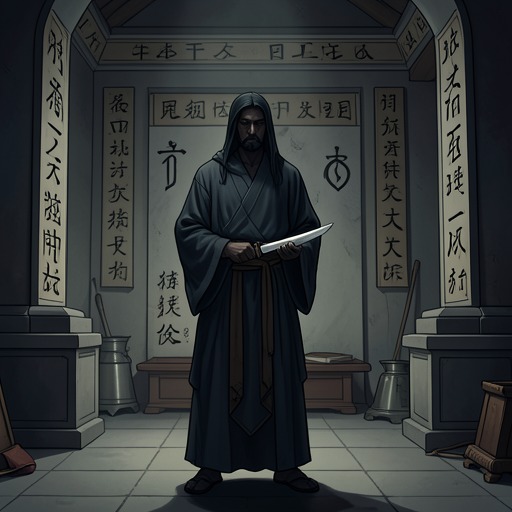
Helicopter Shatters Temple Room Skylight, Injuring Mal’akh
The Lost SymbolThe helicopter shattering the Temple Room skylight is the sudden reversal that breaks Mal’akh’s planned sacrificial transformation. As he lies on the altar expecting a supernatural passage into a new state, the impact sends glass into the chamber, wounds him, and exposes the difference between the ritual he has imagined and the painful reality that follows.
The Ritual at Its Climax
The event unfolds in the Temple Room of the House of the Temple, a chamber already charged with ritual meaning. Earlier in the evening, Mal’akh had entered a thirty-third-degree Masonic ceremony, drinking from a skull as he swore an oath before the assembled brothers. The ceremony’s language of secrecy, death, and initiation gives the later scene its deliberate ritual frame: Mal’akh treats death not as an end but as the passage to the transformation he has planned.
At the climax, he lies on the altar while a knife is raised over him. Mal’akh believes the rite is proceeding as intended and expects a brilliant revelation rather than ordinary death. Robert Langdon rushes toward the altar, trying to stop what he believes is an attack on Peter Solomon. In the confusion, he tackles Peter, who is not the person lying exposed on the altar. The reversal reveals that Peter is alive and that Mal’akh has made his own body the intended offering.
The Helicopter and the Shattered Oculus
The helicopter’s searchlights sweep into the chamber through the large glass oculus, while a laser sight passes across the floor toward Langdon and Peter. No shots are fired. The helicopter’s blades instead send a powerful downward force against the glass. Because the pyramid beneath the aircraft diverts that force sideways, the pilot struggles to lift away; a landing strut strikes the center of the skylight, and the oculus bursts apart.
The helicopter’s arrival also coincides with the final stage of Mal’akh’s attempted transmission of a recording of the Masonic initiation. The laptop on a chair shows that the message has reached 100 percent completion just before the glass breaks. The collision does not erase that displayed completion, even as the descending shards transform the scene from a controlled ceremony into a physical emergency.
Injury and Interrupted Transformation
Glass falls onto the altar and cuts Mal’akh across his body. The broken Akedah knife lies beside him, smashed against the granite rather than driven into Peter. Mal’akh recognizes that Peter has averted the knife and refused to spill his blood. His envisioned transformation does not occur: there is no welcoming light, only pain, darkness, and the immediate presence of other people in the room.
The event therefore interrupts the ritual without ending Mal’akh’s life at once. He remains on the altar, wounded and alone after the helicopter departs, while the chamber’s sacred staging has been broken open by the shattered roof. In the ensuing moments, he cannot see and hears Langdon reassuring Peter that Katherine is safe. The attempted passage from mortality to power instead leaves Mal’akh alive in pain, confronted by the survival of the people he had sought to destroy and by the failure of the outcome he expected.
Consequence and Significance
The skylight’s destruction is both a physical intervention and a reversal of Mal’akh’s ritual design. The chamber’s great opening, which had admitted moonlight into earlier ceremonies, becomes the route through which the glass falls and the imagined revelation is replaced by injury. The scene also confirms Peter’s decisive moral refusal: even after being held captive and threatened, he does not kill Mal’akh when given the chance.
For Langdon, the event corrects his mistaken understanding of who is in danger on the altar; for Mal’akh, it destroys the certainty with which he had interpreted the ritual. The helicopter does not simply interrupt a ceremony. Its impact exposes the gap between Mal’akh’s belief that he can command transformation and the human choices and material consequences that defeat his plan.